Jul 9, 2013

A Visit to Farm Girl Natural Foods


 - written by guest blogger, Angela Gardner after a farm tour in April 2013.
Driving along highway 10, through the Lake Maumelle Watershed and towards the misty convergence of Ozark and Ouachita hills, Sam Hedges and I quickly find ourselves immersed into the rural landscape of Perry County.   We have ventured out of the city to visit two farms nestled into this land and gain an understanding of how these sustainable powerhouses supply numerous retail and business operations in central Arkansas.  Our first stop for the day is Farm Girl Natural Foods operated by Katie Short and company.
Growing up in Berkeley, California, immersed into a developed culture of local food and liberalism, Katie intuitively knew that she was a farmer, connecting her aptitude for natural science and creative work with her hands.  As a teenager she notes the homogeneous urban elite identity that was created over the years as budding a curiosity and rising to see a new world of “true salt of the Earth” farmers.  With the local food markets already established by veteran farms and affordable productive land hard to find, Katie decided to venture out of Berkeley and seek opportunities where a young farmer could experiment, learn and work with the land.  Her first (and only) stop was Heifer Ranch, the launching pad for Farm Girl.
???????
One of Farm Girl’s many stocked freezers in their farm store.
Over the years, the success of Farm Girl has expanded to a 30 acre wooded homestead where we first meet Katie.  She leads us into their new farm store, built out of sweat equity and filled with freezers for meat shares, milk jars and timeboards for the farm.  Every Thursday from 10am-6pm, the store provides customers an opportunity to come out and deepen their ‘farm-to-table’ experience.  Bring the whole family for a great educational day trip!
????????????
Land restored to productive beauty thanks to Katie’s pigs
Venturing out of the building, Sam and I, though ill prepared for the terrain and weather, set forth into the scrubby forestland in wonder at what may lie beyond the grassy slope.  Through the clearings, Katie points out the landscape impact hogs create under a woodland grazing rotation. These porkers do a fantastically efficient job of clearing out understory brush, providing an ample opening to reseed the area in regionally appropriate cover crops.  This cooperative act of clearing and reseeding in rye and clover helps to enrich the properties and nature of  soil by replenishing nutrients to the surface layer, and, I might add, it’s nicer on the ankles to romp through.
?????????????????????
Industrious pigs at work on Farm Girl’s woodlands.
Approaching an undisturbed section of woodlot, we are introduced to the first litter of hogs busily roaming the new terrain of lush wilderness.  The pigs are rotated to a new 1 acre area twice a week in order to maximize grazing, add nutrients to the land (in the form of manure) and limit soil compaction.   For all of their livestock, Farm Girl uses mobile electrical fencing for pasture rotation as it is easy to work with and adaptable for any terrain.  At (4) months old they had not yet ventured too far from the grain feeder but had already started working on the vegetation.  The pigs associate the grain feeder as a ‘home base’, a familiar comfort zone, when they move into the new lots.  The grain is supplied as a supplement to their diet to ensure they are receiving all the nutrients that are required for their growing bodies.   These are some of the healthiest and most inquisitive pigs in the region.  They are a mix of 4-5 different breed lines that Katie has been experimenting with over the years in order to select physicality traits that work best for her operation as well as the overall innate nature of the pigs she raises.  She tells us that she is particularly fond of the red haired pigs as they seem to cope with the sun and heat better than their fair and dark haired cousins.
????????????????
Buster, a 3,600lb boar
Deep snarls and grunts reverberate through the trees as Katie leads us up the hill to visit the breeder pen.  Sam and I meet Buster, all 3,600 lbs of him, and stand in awe at the shear amount of life in front of us.   He shares the pen with three sows, one of whom, Mudpie, is due to deliver soon.  Beneath this canopy of trees, another litter will soon begin their journey from woodlot to woodlot, grazing to their hearts’ content while frolicking amongst the clover.
?????????????
Baby chicks beneath the warm glow of the heat lamps.
Pigs are a big market for Farm Girl but chickens certainly have their share of conscious nurturing from brooding to customer.  The chicks that are raised at Farm Girl are purchased from S & G Poultry, who specialize in breeding chickens for southern US pastures.  Red Rangers and Naked Neck (or Poulet Libre) are the broilers and Grey Ladies are the lead laying flock that Katie has purchased from S&G.  While sitting in the brooder surrounded by 300 baby chicks, we learn that these ‘classic’ varieties are traditionally bred and raised to naturally maximize their potential physical nature (equates to a more developed flavor and natural growth development) whereas most conventional chicken operations use breeds that were developed for speedy frankenstein-ish growth habits that are not only are detrimental to the health and wellbeing of the animal but also distort our concept of humane agricultural production.  She understands that agriculture is a business and needs to be profitable and by focusing on these varieties of chicks and livestock, Farm Girl Foods is paving a middle ground for the community.  By being built upon this ethical foundation for all of their animals, Farm Girl Natural Foods has recently been granted their Animal Welfare Approved status. Way to go Farm Girl!
For the final leg of the Farm Girl tour, Katie takes us to Heifer Ranch where we journey towards 10 acres of the Fourche La Fave River Bottoms leased to Farm Girl for their cattle and roaming chickens.  Along the way, the mist begins to accumulate into light rain droplets and as the breeze flies through the fields I again realize that I should have brought a jacket…..what a chilly spring we have had this year.
??????????
Stepping out onto the land toward the chicken pasture, my eyes soak up the blurred scenescape of rolling mist, clouds and green hills.  Our route through the tree break creates a corridor of vibrant colors and sounds as the wind blows the pine branches Donkeyabove us.  This technique of planting trees along the fence row provides not only an aesthetic function but multiple purposes for the farmer:  a wind break, shade for livestock and firewood.  Breaking through the pathrow of pines, Katie takes us onto a fenced patch of land where the mobile chicken coops are housed.  Currently there are 2 houses in production with two more houses ready for action.  After 2 weeks in the brooder, the chickens are relocated to a mobile chicken house where they are moved twice daily with the help of a living tractor: the antiquated farm donkey.  Again Katie points out the lush vegetated patches where the chickens have moved through providing generous nutrients for cover crop reclamation.
???????????Heading to the last pasture of our tour, we follow Katie towards a mob of grazers: Jersey cows, a donkey and a Shetland pony. Being managed by a practiced grazier, this ultra high density forage-cattle interaction, know as mob grazing, produce quality gains for cattle (a grass-fed diet) and much higher than average gains from the land (a manure-fed diet).  As Katie talks about how she utilizes the Jersey breed for both milk and meat, the donkey makes a bee line straight for us.   After a few pets and acknowledgements of our attention, we learn more about the efficient physiology of Jersey cows to convert grass into fat providing both flavor and marbling that customers seek in meat products as well as flavor and fat content for milk products.  These cattle are rotated through the pastures twice a day and are milked every morning.  Milk shares are a new venture at Farm Girl, for more information please contact Katie Short.  Be sure to check out their blog.
At Farm Girl, they are aspiring to capture the land of their flocks and herds, the ‘terroir’ of Perry County.  Try their offerings of sausages, chicken, pork or beef available on littlerock.locallygrown.net, Argenta & Bernice Garden Farmer’s market and see if you can taste the place.  Before we head onto the next leg of the journey, Sam and I give a cheer to real food with fresh raw milk and share our delight of this liquid ice cream that only Jersey cows grazing on the county of Perry County flora can naturally express.
?????

Savor local flavor y’all!

by Angela Gardner 

share facebook tweet

Jul 5, 2013

Roasted Red Peppers {Preserved by Lacto-Fermenting}

Last fall my friend Brandy made and gave me lacto-fermented roasted red peppers. They might be my all time favorite fermented food.  She used the recipe straight from Nourishing Traditions.  If you've tried to like sauerkraut but just don't - well, let me encourage you to try these.  They're not too far from "normal."  If your family freaks out about the word "ferment" then just call it "pickled."

{Currently I'm not in my home kitchen so I had to make due with a few substitutions - like a pickle jar instead of a mason jar and aluminum pie pans instead of glass roasters.  It's all good.}

Onward and upward.

First preheat the oven to 450*.  Cut peppers in large-ish chunks and lay them skin side up in an oiled dish.  I used coconut oil and aluminum pan.  Three abnormally large red peppers and two pie pans were harmed in this demonstration.
Roast for 10 minutes or longer until you see blisters forming.  The blisters are important for removing the skin later.  Once you have decent blisters, flip them over and roast the other side for 10 more minutes.  Blistering could also be achieved over a flame (think grill or campfire).
When sufficiently roasted, sweat the skins in a plastic bag for about 10 minutes.
Now peel the skin off your feet peppers.  It's an easy task if they blistered properly.  A few of mine didn't blister completely and I couldn't get the skin off.  So I just left it on.  For the most part the skin came off easily.  Next time I make these, I will really burn these babies.

Now you have roasted red peppers.  Of course you can stop at this point or you can keep going and ferment them to increase their vitamin C as well as enzymes and probiotic power.

“The proliferation of lactobacilli in fermented vegetables enhances their digestibility and increases vitamin levels. These beneficial organisms produce numerous helpful enzymes as well as antibiotic and anticarcinogenic substances. Their main by-product, lactic acid, not only keeps vegetables and fruits in a state of perfect preservation but also promotes the growth of healthy flora throughout the intestine.”

  --Sally Fallon, Nourishing Traditions, pg 89

To get a strain of lactobacilli, you can use the liquid that puddles in your yogurt container (or strain the yogurt to get this whey).  I have also used starter liquid from other ferments like sauerkraut. 


In a clean glass jar, dissolve 1 tablespoon of sea salt into 1.5 cups of warm, de-chlorinated water.  Next add 4 tablespoons of whey.  Drop your pieces of roasted red pepper in the jar then screw on the lid.  Be sure to leave some head room at the top of the jar.
Twelve hours later I had to relieve the pressure from the jar.  When you see bubbles forming on the sides or near the bottom (like above my thumb nail in below picture) that's when you know magic is happening.  Eventually I left the lid un-screwed (is that a word?).  The pressure kept building and I had other things to do than stand around and relieve pickled pepper pressure.  Say that 3 times fast.
Let it ferment or pickle on your counter for 3 days then refrigerate.
Mexican Potato Salad

How to use this delicious goodness:
- in hummus
- on a green salad
- give color to potato salad
- pasta salad
- sky's the limit!

Be sure that when you add a ferment to food that the food is cooled enough so as not to kill the beneficial bacteria.  Just don't add it to a casserole and bake it.

Other fermented pickled peppers:
banana peppers
jalapeno peppers

-Julie
EDIT: Cultures for Health says that whey or a starter is not need for peppers.  If I have extra whey, or starter from a previous ferment, I like to use a little to ensure that "the good guys win."

share facebook tweet

Jun 26, 2013

Frozen Yogurt - Super Easy for the Kids

When the familiar tune of the ice cream truck wafts in the air, my children are giddy.  I get a pit in my stomach.  The song sticks in my brain for hours, the prices are exorbitant, and the ice cream, if you dare to call it that, is chocked full of high fructose corn syrup and artificial colors.  I hate that truck.  There, I said it. 

The other day at the grocery store, I had a brilliant flash of the obvious.  I need to freeze my own frozen yogurt.  Many of you are saying, "Julie, I've been doing that for years."  Call me slow. 

I bought a package like this and popped it in the freezer.  Voilà.  Frozen yogurt.
My kids love the packaging.  And I do too.   Cool and refreshing like ice cream, sweet enough to stave off a craving but the quantity isn't enough to ruin dinner.  My kids feel like they have had ice cream.  I feel like I'm letting them indulge in one of the treats of summer but not giving them junk.  And these don't break the bank.  Win-win.

Maybe my next business venture will be to drive my mini-van around the neighborhood rockin' out some New Kids on the Block and selling frozen yogurt for the sake of real food.

Julie

share facebook tweet

Jun 11, 2013

The Village Market on Wednesdays

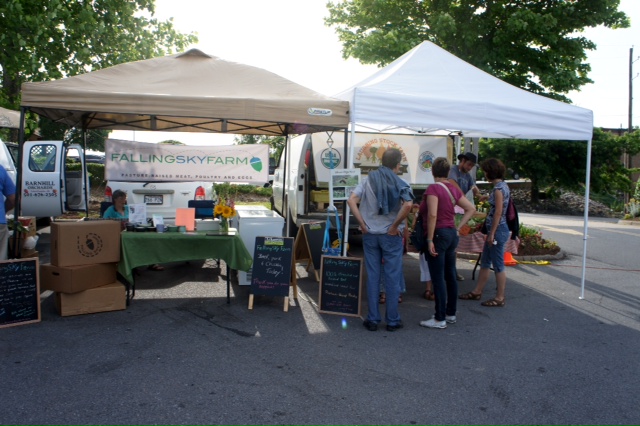
If you miss the farmers markets on Saturday, there's now a mid-week option for you.  In the Whole Foods parking lot (Rodney Parham & I-430) on Wednesdays from 4-7pm you will find The Village Market.


Currently the farmers in attendance are Josh Hardin with Laughing Stock Farm, Kelly Carney with North Pulaski Farm, Kent Walker with Kent Walker Cheese, Bob Barnhill with Barnhill Orchards, Andrea Todt with Falling Sky Farm, and Tara Stainton of Rattle's Garden.  Occasionally there is a mobile grill and The Village Market anticipates more farmers joining them throughout the summer.

When shopping at Whole Foods, and it works with your schedule, try to visit The Village Market on Wednesdays from 4-7pm and support our local farmers!

share facebook tweet

May 30, 2013

Favorite Recipes from Real Food in Little Rock


I'm excited to present to you a list of some of my favorite recipes on this blog.  Are you stuck in a rut?  Want to try something new?  Peruse this list.

Think of this list sort of like a virtual church cookbook.  You know the plastic spiral bound cookbook that grandma or mom used to cook from.  It has splatters and stains with pencil marks throughout, pointing to the best tasting and most loved recipes.  Well, secrets like those are exposed on the blog.  All of these recipes have been tested and enjoyed very much.  Be sure to read the comments, too - some great tips are hidden within.

When you want to access this list after today I've made a tab at the top of the blog marked "favorite recipes" for you to find later.


Breakfast
Breakfast Cookies
(Christmas) Brunch Casserole
Granola
Granola Bar Cookies
Oatmeal Bake
Whole Wheat Muffins (soaked)

Lunch
Chicken Salad
kid lunch ideas

Dressing and Sauces
BBQ Sauce
Creole Seasoning
Italian
Mayonnaise making for dummies (complete with video)
Meat Marinade
Pesto
Ranch and Honey Mustard

Sides
Brown Rice Salad
Butternut Squash on the stovetop
Caponata (like bruschetta but with eggplant)
Green Tomato Salsa
Hummus
Kale Krisps
Okra and more Okra
Pineapple Cheeseball
Quinoa, Swiss Chard and Feta
Roasted Bok Choy
Soaked bread for the bread maker
Warm winter salad with arugula, beets and sweet potatoes
Zippy Potato Salad

Snacks
applesauce and fruit leather
chocolate syrup
coconut macaroons
easy ice cream (with frozen bananas)
energy bars
Fruit snacks from zucchini
hummus
kale krisps
quick party snacks
real cheese dip
roasted black mission figs
snacks for babies
no bake coconut cookies


Lacto-fermenting
banana peppers
cranberry chutney
jalapeno peppers
kimchi (Korean sauerkraut)
radish relish with turnips
dilly carrots

Main Dish

I've marked the inexpensive recipes with $.
The fast recipes are marked *
Recipes suitable for freezing are denoted #


Black Bean "burgers" $
Beef Tips and Rice #
Burritos (and how to package for the freezer) #
Cream of Mushroom Soup #
Crepes *#
Carnitas (pork in slow cooker) #
Chicken a la King #
Chicken Curry #
Chicken livers (pan fried)
Chicken and Rice Soup (video) $#
Chicken Pot Pie #
Chicken Salad
Chicken Spinach Stew #
Enchiladas - Beef or Chicken #
Falafel #$
Gazpacho (chilled summer soup)
Ginger Peach Gumbo
Liver - hidden in hamburgers
Mulligatawny Soup #
Oven Risotto
Poached Egg in Marinara $*
Red Beans and Rice for Slow Cooker $#
Stewed Chicken for burritos
Stir Fry - using cabbage with coconut and sesame oil $*

How to cook a whole chicken
How to cut a melon for a party
How to debone a chicken in less than 4 minutes (video)
How to make butter
How to make coconut milk
How to make vanilla
How to make kombucha
How to make natural household cleaners
How to preserve green beans
How to render lard

Tips for eating less meat (plus a recipe)
Tips for making a green salad FAST
Tips for Tasty Greens
Tips for getting your man on the real food wagon

Batch Cooking

share facebook tweet

May 29, 2013

Strawberry Mint Water

Recently I told you about serving this "Strawberry Mint Water" at a party - and how popular it was, especially for those who are watching their waistline.

The frozen strawberries and fresh mint flavor the water ever so slightly.  I like to use a sun-tea jar with a spigot at the bottom so that the strawberries stay in the jar as guests fill their glasses.  Then I add more cold water and ice as needed.

 A friend has also recommended the combination of cucumber and mint.  She calls it "spa water."

-Julie

share facebook tweet

May 27, 2013

Lacto-Fermented Dilly Carrots

Lacto-fermenting sounds like a stinky, maybe scary endeavor.  Let me assure you that it is easy and very yummy.  It's a time-honored way to preserve food (think: sauerkraut the way your great-grandma used to make it.)  More than food preservation, it is a way to introduce billions of friendly bacteria to your gut.  In our sterilized, hand-sanitized world, believe me when I say you need more bacteria in your belly. 

This recipe is a sneaky way to get it in the tummies of your most picky eaters.

It doesn't look weird.  It's just carrots.  They taste a bit pickled.  And another beauty of lacto-fermented foods is that you don't have to eat a whole jar to get the benefits.  Just a couple tablespoons will do a lot of good.
Because I knew we would eat them at a rapid rate, I made a giant batch.  However, if you're not certain that your crew will devour them, you can do a small jar.  Just adjust the ratios.  You can hardly mess it up.  I promise.

I bought a 5 pound bag of organic carrots and shredded them in my food processor.  However, if you wanted to shred enough for a pint jar, you could do the shredding by hand.

Because I like garlic, I added a few cloves (and shredded radishes from my FarmShare) but you could omit either or both.  Then I sprinkled enough dried dill into the carrots so that I could see it.  I wanted to be able to taste the dill.  Next you want to sprinkle sea salt into the mixture - about 1 tablespoon per quart.
The salt will pull out some moisture but you will probably need to add more water. (Be sure it is de-chlorinated water, so that the chlorine doesn't kill our friendly bacteria.)

The last step was adding 1 T whey per quart.  Whey seems to trip up people who haven't stepped into lacto-fermenting.  "Where do I get it?" they ask.  Well, since you asked...  you know that liquid that seems to sit in a pool once you've scooped out some yogurt?  That's whey.  You could drain more whey from yogurt using a coffee filter or cheese cloth.  For the visual learners, watch this one minute youtube video.  Let me recommend using non-flavored yogurt. :)  Since I have a bunch of jars of lacto-fermented things in my fridge, I usually just mooch a little starter liquid from something else.

Once everything is in your air-tight jar, let it sit on your counter for 3-5 days depending on the temperature of your kitchen.  The warmer it is the faster the magic happens.  You can taste after 3 days to see if you like it.  Then refrigerate.

What do to with these lacto-fermented carrots?

-Sprinkle on a green salad.
-Use in brown rice salad or a pasta salad.
-Hide them in chicken salad.
-Eat them as is.  Delish.

The sky is the limit, really.

-Julie
PS - because carrots have a higher sugar content, they will turn to alcohol after a few months.  They do not keep in the fridge as long as sauerkraut (about a year!).  But these carrots will keep for a couple months at least.

share facebook tweet

May 24, 2013

Reminder for Real Foodies

This vinyl wall art was a Mother's Day gift (that I requested.)  I need a visual reminder that yes, my kitchen will be messy and for good reason.  People I love are being fed nutritious food that takes time to create.  If I didn't have people to feed real food, my kitchen would be spotless all the time.  I'll take the mess.

-Julie

share facebook tweet

May 22, 2013

Baked Beans:: Without Corn Syrup

A friend of mine is very sensitive to corn syrup.  So sensitive in fact that he throws up if he eats it.  (Making someone sick is not something I want to be accused of at a picnic!)

The ideal thing to do would be to make the beans totally from scratch.  Well...keepin' in real here - I don't make everything from scratch.  *shock, I know*

I had been slated to bring baked beans to a picnic and was given strict instructions to double check the ingredients so that this friend would not throw up.  A specific brand of pork and beans was even suggested.

Doing my duty, checking the back of said brand, low and behold, high fructose corn syrup was an ingredient!  I called my friend and said, "The brand you suggested has corn syrup."

What?  They didn't the last time I bought them.

So I started reading the backs of all the cans.  Showboat brand was the only one I found that day that didn't have corn syrup in them.

It was the brand I bought that day and continue to buy (at Kroger).  When I make baked beans now, I use this easy homemade BBQ sauce, some bacon and sauteed onions and green peppers.  Almost always every last bean is eaten when I take them somewhere.  Probably the only person that knows corn syrup is NOT in them is my friend who doesn't throw up.

-Julie

share facebook tweet

May 21, 2013

Lara, Power, Energy Bars of Goodness

My husband really likes to exercise (freak).  The last nine months or so he's been cycling and finding that he needs a source of nutrition on the longer rides.  Last week he asked if I could make some energy bars.

Big mistake.

These things are so yummy in my tummy.  I could eat the whole pan.  It is taking every ounce of self control that I can muster not to polish them off before he gets home from work.

There are a bajillion recipes out there.  I started by looking at a few then scoured my pantry for goods on hand and this is the recipe for today.

In a food processor, put everything in at once:

1 cup dates 
1/2 cup craisins
3/4 cup almonds
1/4-1/2 cup walnuts
2 Tablespoons coconut oil
3/4 t  sea salt (really, to taste - my man wanted them saltier because he needs the electrolytes on the longer rides)

Give it all a whirl until it looks like it will stick together.  Line 8x8 pan with parchment or wax paper then press mixture into the pan and refrigerate. 

At room temperature it is a bit crumbly.  I'm wondering how this snack will transport.  Rolling the goodness into a ball might be a better option.

You have been warned, though.  These are serious good.

-Julie

share facebook tweet

LinkWithin

Related Posts with Thumbnails